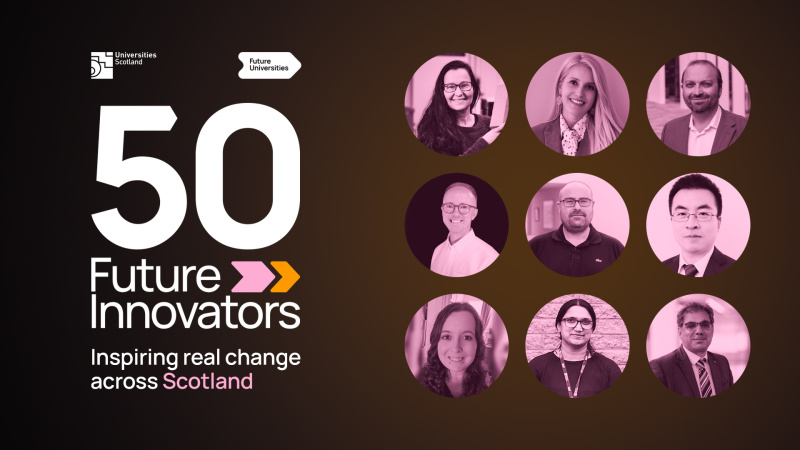
- Nine innovators working in Scotland’s universities have been named in a UK’s top 50 “power list” meaning Scotland is better represented than any other nation or region of the UK.
- Polling with the Scottish public suggests that 6 in 10 people agree, or strongly agree, that university research meets the real world needs of business.
- Scotland’s strength in 50 Future Innovators demonstrates significance of universities as an innovation asset to both the Scottish and UK Governments.
- Read more about the Future Innovators here.
50 Future Innovators is part of Future Universities, Universities UK’s campaign making the case for the economic and social contribution of universities.
The list celebrates people whose work has been made possible by a UK university, to show what can happen when talent is backed wherever it starts, and to inspire a new generation of innovators to follow in their footsteps. The Future Innovators “power list” is focused on new and emerging talent, celebrating the individuals behind just some of the inspirational work coming out of UK universities in the last five years.
Scotland’s strong representation in a UK power list suggests the nation’s innovative future remains as vibrant and impactful as its past history of invention and discovery, in large part due to its universities as a major asset. With nine of 50 Future Innovators linked to Scotland’s universities, Scotland is the best represented nation or region of the UK, beating London which has eight.
The economic impact of university research is recognised by a majority of the public, with polling across Scotland earlier this autumn finding that 6 in 10 people agree or strongly agree that university research meets the real-world needs of businesses trying to improve their products or services. However, more than 3 in 10 people neither agree nor disagree, suggesting that universities’ research and innovation is not as visible to the public as it could be. Initiatives like Future Innovators can help to address that.
The list of 50 Future Innovators comes hot on the heels of significant speeches from both the First Minister (September’s five-year Programme for Government) and Prime Minister (October’s Innovation Summit) on the importance of innovation for economic growth and place-based impact.
Speaking to Scotland’s strong performance in the 50 Future Innovators list, Professor James Miller, Convener of Universities Scotland said:
“Scotland’s universities are among the most powerful engines of innovation, discovery, and societal progress anywhere in the world. Across every institution, from our ancient universities to our modern pioneers, researchers are tackling some of the most pressing challenges facing humanity and advancing solutions that directly support the United Nations Sustainable Development Goals – turning discovery into impact.
The breadth and ambition of this work is extraordinary. From bacteria capable of transforming plastic waste into life-saving medicines, to stretchable electronic skin that could revolutionise healthcare and robotics, to sustainable construction materials that reduce environmental impact, Scotland’s research community is demonstrating how world-class science can improve lives, strengthen economies and protect our planet.
Investment in research is an investment in a more prosperous, sustainable, and equitable future.”
Minister for Innovation, Technology and Tertiary Education Alyn Smith said:
“This is what the future looks like. Inspirational people putting our university sector at the forefront of innovation, to deliver transformational change and financial sustainability for the future.
“I congratulate all of these pioneering researchers for making this prestigious list of the UK’s Future Innovators. I’m encouraged to see work being done across a breadth of industries, from veterinary health to construction, while also harnessing the latest technology including AI to make a real and lasting impact.
“The Scottish Government is committed to supporting our world-class universities, which make a crucial contribution to Scotland’s workforce and economy. By breaking down barriers between education and business, we are revolutionising Scotland’s skills landscape so it meets the needs of learners and employers.”
Professor Gabriela Medero, one of the Future Innovators and Professor of Professor of Civil Engineering at Heriot-Watt University, who invented the K-BRIQ, a brick made from construction waste, with 95% less carbon than a clay brick, said:
“Universities have the unique ability to help people imagine what is possible and provide the knowledge, support and networks to turn ideas into reality. My journey led to the development of the K-Briq and the co-founding of Kenoteq, transforming research into a business focused on reducing waste and carbon emissions in construction. Seeing an idea evolve from the laboratory into a product with real-world impact has been incredibly rewarding and reinforces my belief in innovation as a force for positive change.”
Baroness Beeban Kidron, Crossbench Peer in the House of Lords, Founder of the 5Rights Foundation and member of the Future Innovators judging panel, said:
“What struck me most in judging 50 Future Innovators was the sheer range of people and ideas: scientists, founders, artists and designers, from every part of the UK, each solving a real problem for real people.
“Innovation is at its best when it serves the public good, and this list represents ideas which can genuinely improve lives of people across the UK and beyond. These innovators show young people that changing the world isn’t reserved for the few, and that a university can be where that journey begins.”
The 9 Future Innovators working in or linked to Scotland’s universities (listed in no particular order) are:
- Professor Gabriela Medero FRSE, Professor of Civil Engineering at Heriot-Watt. Professor Medero has been recognised for the K-BRIQ, an unfired brick made from construction waste with 95% less carbon than a clay brick. It can now be used in commercial projects across the UK, Keynoteq’s East Lothian based factory s scaling up to produce two million bricks a year and it is now stocked by B&Q.
- Dr Adriana Portella, Assistant Professor in Health Geography at Heriot-Watt University. Dr Portella has been recognised for Amazon Indigenous Wisdom, which brings Indigenous knowledge into climate research.
- Professor Hadi Larijani, Professor of Computer Networks and Intelligent Systems at Glasgow Caledonian University. Professor Larijani has been recognised for an ultra-thin, gel-free EEG headset for brain monitoring at home.
- Professor Stephen Wallace, Professor of Chemical Biotechnology at the University of Edinburgh. Professor Wallace has been recognised for engineered bacteria that turn plastic waste into medicines.
- Professor Asier Unciti-Broceta, Professor of Medicinal Chemistry at the University of Edinburgh. Professor Unciti-Broceta has been recognised for NXP900, a new cancer drug now in clinical trials.
- Dr Yunjie Yang, Senior Lecturer in the School of Engineering at the University of Edinburgh. Dr Yunjie Yang has been recognised for stretchable electronic skin that gives soft robots a sense of touch.
- Michaela Thorne, veterinary surgeon and the founder of AI for the Eye Ltd. Michaela Thorne has been recognised for AI for the Eye, which uses retinal imaging to screen cattle for bovine TB. The work grew out of Michaela’s PhD at the University of Edinburgh and has been assisted by Robert Gordon University’s optical engineers, helping to build the device.
- Dr Lethy Krishnan Jagadamma, Reader in Physics at the University of St Andrews and a UKRI Future Leaders Fellow. Dr Lethy Krishnan Jagadamma has been recognised for materials that turn light, heat and movement into electricity to power wireless sensors.
- Professor Naeem Ramzan, Professor of AI and Computer Engineering and Director of AHCSE Research Centre, University of the West of Scotland. Professor Ramzan has been recognised for contactless AI that monitors the wellbeing of young people in secure care.
ENDS
For further information: Susannah Lane, Head of Public Affairs. M: 07715992908.
How the 50 Future Innovators were chosen:
The Criteria entries to the 50 Future Innovators were judged on included:
- Groundbreaking: Individuals at the helm of original work, no matter their field. Whether they are manufacturing a new sustainable material using an ingenious method, developing an economic model that reimagines how we distribute a vital resource, or creating an entirely new form of artistic performance to engage a local community, they are celebrated.
- Contemporary: The individual’s work has emerged within the last five years, with real potential to shape the future. Their innovation, no matter their age or experience, is having an impact in the here and now with the potential to change how things are done in the future.
- UK University-linked: A UK university was instrumental in realising the individual’s work with a clear and meaningful connection.
- Impactful: Creating real and meaningful change in people’s lives with a particular interest in nominations where an individual is addressing a real and pressing need, despite obstacles, through determination and ingenuity.
A panel of independent expert judges scored the shortlist against the four criteria. Each judge assessed nominations individually, and the scores were then brought together to determine the final list. Their expertise and independence are what make the final 50 credible, fair and genuinely balanced across sectors and regions.
The Judges were:
- Baroness Martha Lane Fox – Co-founder of lastminute.com
- Dr Darren Henley CBE – Chief Executive of Arts Council England
- Dr Anne-Marie Imafidon MBE – CEO of Stemettes
- Baroness Beeban Kidron OBE – Founder of the 5Rights Foundation
- Professor Dame Ottoline Leyser DBE FRS – Regius Professor at the University of Cambridge and former Chief Executive of UKRI
About Future Innovators
Future Innovators is a Universities UK programme focused on the role universities can play in driving UK economic growth through innovation, entrepreneurship and investment.
Additional quotes:
“I warmly congratulate all the innovators, including Scotland’s nine innovative researchers – including two Royal Society of Edinburgh Fellows and one alumnus of the Young Academy of Scotland – recognised among Universities UK’s 50 Future Innovators.
“They demonstrate how Scotland can turn brilliant ideas into breakthrough solutions, stronger businesses that improve lives, strengthen our economy and shape a happier, healthier and more prosperous future for our people.”
Dr Poonam Malik, Vice President for Business, Royal Society of Edinburgh
“Scotland’s strong representation in the 50 Future Innovators demonstrates the quality of our universities, our research and our people. We have the ideas and talent to create world-class companies, growing from Scotland and competing globally.
“Our ambition is to turn more of that innovation into high-growth businesses, creating high-value jobs, attracting investment and driving economic growth. It’s fantastic to see innovators we’ve supported recognised on this list, and we’re determined to help many more follow.”
Nicola Anderson, Director of Scaling Innovation at Scottish Enterprise