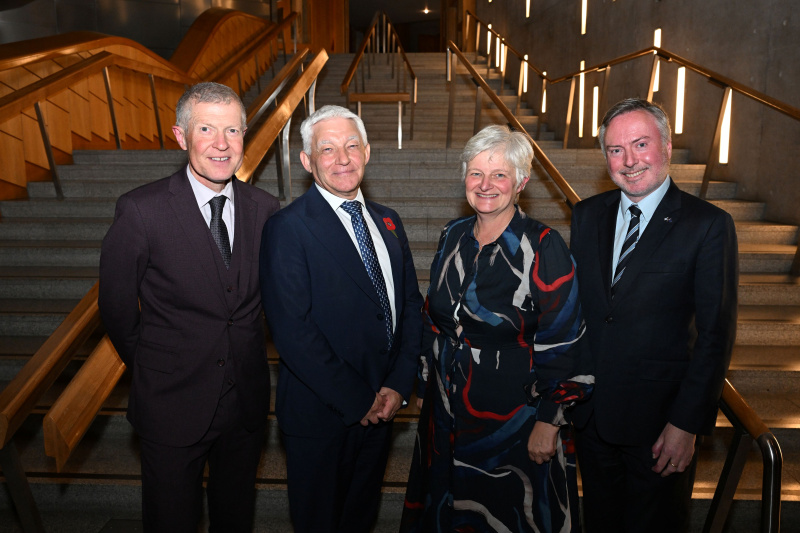
Universities Scotland welcomed Ministers, MSPs, universities, and partners from every corner of Scotland to a reception in celebration of partnership at Holyrood on 27 October.
Hosted by Willie Rennie MSP, with speeches from Minister Alyn Smith MSP, Age Scotland’s Chief Executive, Katherine Crawford, and our very own Professor James Miller, as Convener, the reception took the opportunity to highlight the role universities have in helping to deliver on the Scottish Government’s four priorities of: tackling child poverty, economic growth, achieving net zero and supporting public services.
The event was an opportunity to bring to life the Universal Partners campaign, which launched earlier this year.
Katherine Crawford spoke to the long-standing, research-focused partnership between Age Scotland and Heriot-Watt University. The organisations recently deepened the partnership through a Memorandum of Understanding and have worked together to tackle dementia and support healthy ageing.
In speaking to guests about Universal Partners, Professor Miller said:
Taken together, this range of projects represent a national partnership infrastructure that already exists and delivers value every day.
When people think about universities, too often they focus on what happens on campus. But, so much of universities’ impact is felt far beyond the campus.
That impact is felt in hospitals, schools, businesses, communities and government itself.
The impact of Scotland’s universities is woven throughout the fabric of our society. That is particularly important at this moment.
As a nation, we face profound transitions: the transition to a net-zero economy; the transition to an AI-driven economy; the transition towards more preventative and sustainable public services.
And, perhaps most importantly, the transition towards lifelong learning, where people will need to upskill and reskill throughout their careers.
Universities will be essential partners in every one of those transitions. That is why investment in universities should never be viewed simply as expenditure.
It is an investment in Scotland’s future capacity to succeed.
Amongst the 19 different examples of partnership featured during the evening reception were:
- The University of the West of Scotland’s partnership with Oxfam Scotland has helped bring academic expertise and lived experience together to influence public policy around poverty and inequality.
- The University of St Andrews’ partnership with Stagecoach and Moffat & Williamson has enabled staff and students to access affordable public transport while significantly reducing carbon emissions and household travel costs. It supports climate action, cost-of-living pressures, community connectivity and social inclusion.
- The University of Dundee’s continued partnership with spin-out MyWay Digital Health. It is transforming diabetes care, locally and globally, with low-cost solutions based on data-driven knowledge which helps advise patients and health-care professionals.
- SRUC’s work in the EGENES Alliance, in partnership with the representative body on behalf of farmers and suppliers, to support the UK’s centre of excellence for livestock genetic and genomic evaluation. This is critical national infrastructure for the dairy, beef and sheep sectors.
- Glasgow School of Art’s partnership with STAC, a company co-founded by graduates, supports entrepreneurs and fellow GSA graduate startups and which is building Scotland’s future tech economy spanning critical future industries including drones, robotics, MedTech and clean tech.
ENDS